
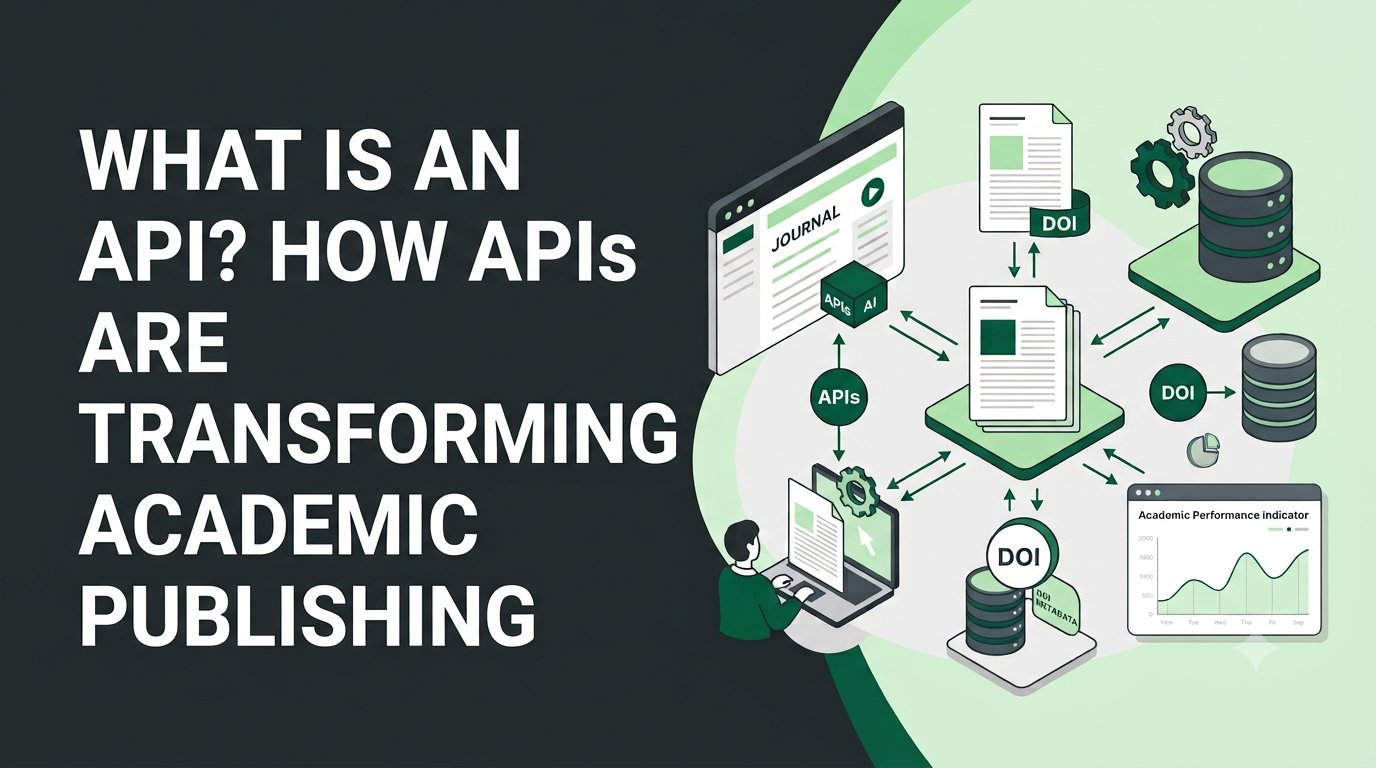
Understanding the Academic Performance Indicator (API) in Academic Publishing
Academic publishing is no longer just about publication of research papers. Academic institutions and universities consider a variety of factors when evaluating faculty member's academic achievements such as teaching, research, publications, conferences, faculty development and research impact.
This is where the Academic Performance Indicator (API) comes into play.
Evaluation can be accomplished through the use of APIs that can allow for a measurement of multiple academic contributions, and, especially in higher education, academic publications can be a key component of a faculty member's academic record. In previous UGC systems, research and academic work were also integrated in the API/PBAS-based evaluation systems. However, the rules and scoring may differ based on the applicable rules and institute.
In this dynamic landscape, researchers are not just wondering about how to publish a paper, but also asking, "How can I publish a paper with a meaningful impact? They also want to know what journal they should use, and if the journal is known or recognized; they want to know how the publication can help them build their academic profile; and how the impact of their research will be shown.
What Is an Academic Performance Indicator?
Academic Performance Indicator: A measurable indicator that is used to evaluate academic performance.
API in higher education can include various aspects of students' academic endeavors, including:
- Teaching and learning activities
- Research publications
- Books and book chapters
- Conferences and seminars
- Research projects
- Patents
- Professional development
- Academic and institutional responsibilities
Previous systems of assessment of faculty performance were also linked to research and academic work as an important subcategory. API-related evaluation is also articulated in the other academic resources in terms of teaching, research, publications, conferences, and professional development.
Therefore, API shouldn't be regarded as just a publication score. It's part of a larger assessment system of student performance.
API Score and Academic Performance Index
In the investigating of API, you will find the term academic performance index as well.
Both of these terms are often synonymous, but may have different meanings in different contexts.
In most cases, an API score is a numerical value assigned to a specific group of academic activities that are eligible for assessment. An academic performance index can be used to refer to an overall academic or aggregate score.
What's significant for researchers is that they follow the terminology and calculation method set in their University or institution, recruitment authority, or relevant regulations.
How to Calculate Academic Performance Indicator Score?
One of the most frequently asked questions is about how to derive Academic Performance Indicator score.
Such a blanket formula cannot be used for all researchers and all universities.
In most cases, an API-based system will determine which academic activities should qualify for the points, assign the right weightage or point to the activity, and then sum up the overall score.
It can be simplified to:
For instance, the evaluation framework could take into account the following:
- Research papers
- Books and chapters
- Conferences
- Teaching activities
- Professional development
- Research projects
- Other academic contributions
Specific points for publications in various journals or databases are included for some online resources. But researchers need to be careful not to take those numbers as gospel. Requirements may change regarding API, and institutions may have their own rules.
For this reason, it is always important to review the most recent guidelines relevant to the specific publication before making any plans for an API specific publication.
How Does Academic Publishing Contribute to API?
The relationship between API and publishing can be distilled to a simple concept:
Research paper is an academic contribution that starts with its research. After it has gone through peer review and is published it will be included in the researcher's publication record. If the article is referenced in other articles and research projects later on, it can also help the researcher's research profile.
Hence academic publishing has been closely linked with research performance indicators.
But just because a paper is published doesn't necessarily equate to a specific API score. The recognition and scoring will be based on the respective academic evaluation framework.
How API Is Changing Journal Selection?
Evaluation of the APIs can affect the selection of journals by researchers.
In the past, researchers used to pay attention primarily to locating the journal that was willing to publish their work. Journal selection is more strategic these days.
Researchers may consider:
- Journal scope
- Peer-review process
- Indexing status
- Journal reputation
- Publication ethics
- Author contribution
- Research visibility
- Citation potential
- Institutional requirements
For instance, when it comes to faculty assessments and the API, the publications in indexed journals, including the journals in the databases like Scopus and Web of Science, would be taken into account.
However, it doesn't imply:
or
The treatment depends on the rules that apply.
The first thing a journal should be is appropriate for the research. The decision should be made based on API considerations and not influenced by API choice alone.
API, Scopus and Web of Science: What Is the Difference?
Scopus and Web of Science are scholarly research databases, whereas API is related to academic performance evaluation.
They serve different purposes.
| Concept | Main purpose |
|---|---|
| Academic Performance Indicator | Measures academic contributions under an evaluation framework |
| Scopus | Provides indexing and research information |
| Web of Science | Provides scholarly indexing and citation information |
| Citation metrics | Measure citations received by research |
| Bibliometric indicators | Analyze publication and citation patterns |
This distinction is important because researchers sometimes assume that being indexed automatically guarantees a specific API score.
Instead, researchers should verify both the journal's actual indexing status and whether that type of publication is recognized by their institution.
What Are Academic Performance Metrics?
Academic performance metrics are quantitative measures to gain insight into various aspects of academic work.
They can include:
- Number of publications
- Teaching performance
- Research projects
- Citations
- Patents
- Conference participation
- Student outcomes
- Professional development
- Research collaboration
These are part of a larger system of measures of academic performance.
None of the above, however, is sufficient to explain the academic quality of a researcher in full. It is possible for a researcher to have several publications with hardly any research impact, but for another researcher to have only a few publications that have a significant impact in the field.
Research Performance Metrics and Publication Metrics
There are various kinds of measurements employed in modern academic publishing.
Research performance metrics can be used to assess research productivity, visibility, collaboration, and influence.
The publication metrics used in research are more focused on published academic work.
Common examples include:
- Publication count
- Citation count
- h-index
- Citations per paper
- Journal-level indicators
- Downloads and views
- Collaboration indicators
- Online attention
These are among the major types of research metrics in publications.
Citation Metrics
Citation metrics are the indicators that help determine the frequency of citation of research publications by other research publications.
While citation counts can be helpful for research visibility information, they should be used with caution. Different disciplines, types of publications and career stages use different citation styles.
Bibliometric Indicators
Bibliometric indicators are based upon quantitative information about the publication and citation of scholarly works.
They can investigate:
- Publication trends
- Citation patterns
- Research collaboration
- Author productivity
- Institutional output
- Journal performance
- Research influence
These indicators are more and more valuable for researchers and institutions in understanding their research landscape.
What Are Academic Publication Metrics?
Academic publication metrics allow researchers to learn what happens to their publications after they are published.
Examples of things researchers can track:
- Citations
- Downloads
- Views
- Indexing
- Author profile information
- Collaboration
- Online attention
These are all useful measures beyond just published papers.
One thing that matters is that a paper will be published, but the longer-term significance can also be gauged by whether other researchers find, read, cite, and build upon it.
Research Impact Metrics Go Beyond Publication Counts
Research impact metrics are employed in order to gain insight into the influence or reach of research.
Research impact can be measured in a variety of ways, such as citation data, h-index, usage statistics, and more.
For example:
- Publication count shows research output.
- Citation count shows scholarly attention.
- Collaboration metrics show research partnerships.
- Usage metrics show reader engagement.
These measurements should not be interpreted as a substitute or a substitute for API itself, but could be used in conjunction with the academic assessment.
API Does Not Mean "Publish as Much as Possible"
One concern with performance-based publishing is that researchers may start focusing only on the number of papers they can produce.
That can lead to poor journal choices, rushed research, or publication in questionable journals.
A better approach is to balance academic requirements with research quality.
| Quantity-focused approach | Quality-focused approach |
|---|---|
| Publish as many papers as possible | Publish meaningful research |
| Choose journals only for claimed points | Check relevance and credibility |
| Focus only on indexing | Verify indexing and peer review |
| Ignore journal scope | Match the manuscript to the journal |
| Chase metrics | Understand research impact |
The purpose of research should ultimately be to contribute something useful to the academic community, not simply increase a number on a performance form.
How Researchers Can Build a Better Publication Strategy
Researchers can have a more structured approach:
1. Understand the applicable requirements
Review the existing regulations of your university, institution or relevant regulatory authority.
2. Choose the right journal
Consider scope, peer review, indexing, publication ethics, editorial information, and fees.
3. Verify indexing claims
Check the claim of a journal being indexed in Scopus or Web of Science by the appropriate database.
4. Maintain proper records
Retain DOI, ISSN, publication information, indexing evidence, acceptance information and author contribution information.
5. Track your research impact
Track citations and other research metrics post publication.
6. Focus on long-term research value
Never choose a journal on the basis of a promise of a certain API score. Consider how useful, relevant, visible and high-quality the research will be in the future.
API and Predatory Publishing
When they are under pressure to boost their academic output, researchers may sometimes be tempted by tempting offers of publication.
Take care with statements like:
- Guaranteed API points
- Guaranteed Scopus publication
- Guaranteed Q1 publication
- 100% publication acceptance
- Fast publication with maximum API score
An ISSN is not enough to ensure that a journal is credible. The same thing applies to the claim of being indexed for a journal.
Familiarize yourself with the peer review, editorial board, indexing, publication ethics, fees and publisher information listed on the journals webpage before submitting your manuscript.
Does Authorship Affect Academic Evaluation?
When publications are used for academic assessment the authorship is also important.
Researchers should be aware of the distinction between:
- First author
- Corresponding author
- Co-authors
- Number of authors
- Author contribution
There are varying views on authorship and co-authorship credit in the various publication systems used for APIs. So, when assigning credit, researchers should verify any institutional rules and not presume that all authors are granted equal credit.
The Future of API and Academic Publishing
API is making a difference in academic publishing, by urging researchers to consider more than just getting a paper accepted.
The shift of emphasis is slowly towards:
Today, researchers have more research performance metrics, research publication metrics, citation information, and more bibliometric indicators than ever before.
The point is, it's not about abandoning academic judgment for metrics. Rather, they can aid researchers in comprehending the scope and impact of their research.
There are three components to a good publication strategy:
Frequently Asked Questions
What is API in academic publishing?
API is normally used to refer to Academic Performance Indicator. Used to assess academic contributions (such as research publications and other academic pursuits).
How to calculate academic performance indicator score?
The calculation is dependent on the evaluation framework. In general, the eligible academic activities are recognized and given weightage or points.
Do research papers contribute to API?
However, research publications may be eligible to contribute to research and academic evaluation under applicable API-based frameworks, the nature of which recognition depends on the specific rules.
Does a Scopus publication automatically increase API score?
No, Scopus indexing and scoring through API are not the same things. Academic credit is subject to the relevant institutional and/or regulatory framework.
Does a Q1 journal automatically provide a higher API score?
Not automatically. It is a journal ranking system (Q1) and an academic assessment system (API).
What are research performance metrics?
Research performance metrics are used to provide information on research productivity, visibility, influence, collaboration, and impact.
What are citation metrics?
Citation metrics provide data on the number of times research papers are cited in other scholarly works.
What are bibliometric indicators?
Bibliometric indicators are based on the numbers of publications and citations to quantify research output, collaboration, patterns of citation, and the influence of research.
Is API the same as an academic performance index?
Not necessarily. The terminology may differ from context and institution, and researchers should adhere to the definitions of their relevant academic framework.