
A research paper goes through many processes other than writing and submitting the document to journals. There is a need for preparation of the paper, choose the right journal, meet its requirements, sign ethical statements, respond to peer reviews, and deal with other aspects during the process of publishing. It helps to understand how to get a research paper published.
This paper explores the entire cycle of research publication, from manuscript writing to journal choice, submission, and peer review to revision and publication ethics, DOI assignment, and the essential waypoints in the research journey.
1. Prepare Your Research Manuscript
Structure Your Paper Clearly
Start by checking whether your research paper follows a logical academic structure. Depending on the study and journal, this may include:
- Title
- Abstract
- Keywords
- Introduction
- Literature review
- Methodology
- Results
- Discussion
- Conclusion
- References
The exact structure can vary by discipline and manuscript type. Always compare your manuscript with the journal's Author Guidelines before submission.
Check Tables, Figures and References
Ensure that all tables and figures are numbered, captioned, and referred to in the text. Verify that all references are complete, formatted uniformly and cited correctly.
Never depend entirely on a reference management package. Always check all important citations by hand before submission. If you are new to research or need some more help in drafting your manuscript, you can also try Professional Publication Services to review your manuscript before submission.
2. Follow the Appropriate Reporting Guidelines
Reporting guidelines help researchers present essential methodological and reporting information clearly. The appropriate guideline depends on the study design.
For health and biomedical research, the EQUATOR Network Reporting Guidelines offers a searchable repository of guidelines of various study types. The typical guidelines are CONSORT for randomised trials, STROBE for observational studies, PRISMA for systematic reviews and the CARE guidelines for case reports.
Finally, two sources for additional guidance in biomedical research reporting include the Guidelines for Medical Research reporting guidelines available at the National Library of Medicine Research Reporting Guidelines
Why Reporting Guidelines Matter
A well-selected checklist before submission may assist in identifying missing information and may help to make the manuscript clearer and more comprehensive. Reporting guidelines should always be used along with the journal guidelines for submission.
3. Choose the Right Journal
Knowing how to publish your research paper also means knowing where to submit it.
Check the Journal's Scope
Read the journal's aims and scope carefully. Your research should fit the subject areas, readership and types of manuscripts the journal publishes.
Do not choose a journal only because its title sounds relevant.
Review Recent Articles
Read several recently published papers from the journal. Check whether they address research questions similar to yours and whether the journal publishes your manuscript type.
This also helps you understand the journal's preferred academic style and typical article structure for research article publication.
Verify the Journal
Before submission, check the journal's ISSN, publisher, editorial information, peer-review process, publication policies, copyright or licensing terms, publication charges and indexing claims.
Indexing should also be verified through the relevant database rather than relying only on statements on a journal website. For a practical explanation of Scopus, Web of Science, ABDC and PubMed, see the Journal Indexing and Selection Guide.
4. Complete Your Pre-Submission Checklist
Before uploading your manuscript, check the following:
| Item | What to Check |
|---|---|
| Scope | The research fits the journal |
| Manuscript | Structure and formatting follow the guidelines |
| References | Citations are complete and consistent |
| Ethics | Required approvals and statements are included |
| Authorship | All authors and their contributions are agreed |
| Funding | Funding information is disclosed |
| Conflicts | Relevant conflicts are declared |
| Data | Data availability information is provided where required |
| Originality | The manuscript is not submitted elsewhere |
| Files | All required documents are ready |
For biomedical publishing, authors can also consult the ICMJE Recommendations for guidance on manuscript preparation, authorship, conflicts of interest and related publication practices.
5. Prepare the Submission
Write a Clear Cover Letter
A cover letter should briefly identify the manuscript, explain its significance and confirm that it is original and not under consideration elsewhere.
Avoid repeating the entire abstract. Focus on why the manuscript fits the journal and what readers can learn from it.
Upload All Required Files
Follow the journal's submission instructions for file formats and supporting documents.
For example, Southern Cross Academic Press asks authors to submit manuscripts through its online system, upload a Microsoft Word file and provide a brief cover letter. Its guidelines also address ethics approval, funding, conflicts of interest and data availability.
Checking the Author Guidelines immediately before submission can help prevent technical omissions.
6. Understand Editorial Screening
After submission, the manuscript normally goes through an initial editorial assessment before external peer review.
Editors may check:
- Whether the manuscript fits the journal's scope
- Basic formatting and submission requirements
- Originality or similarity concerns
- Ethical declarations
- Completeness of the submission
- Whether the manuscript is suitable for peer review
A manuscript can therefore be rejected before external review. Understanding this stage is an important part of learning how can I publish my research paper successfully.
7. Go Through Peer Review
In addition, the submitted paper, if editors accept it on first hand, could be sent out to independent reviewers for further evaluation.
In a double-blind review, the author and the reviewer do not know each other's identity as specified by the journal's review policy.
Reviewers might scrutinize the focus of the research, writing, and research design. Other such attributes could include the research purpose, reasoning, conclusions, impact, and significance.
Editorial review process and double-blind peer review that screened for possible plagiarism with iThenticate and Turnitin screening tools.
You can also review the publisher's Publication Procedure to understand its stated submission, review and publication workflow.
8. Respond to Reviewer Comments
Reviewer feedback may result in a minor revision, major revision, acceptance or rejection.
Use a Point-by-Point Response
A useful response normally includes:
| Reviewer Comment | Author Response |
|---|---|
| Comment 1 | Explain the response and identify the revision |
| Comment 2 | State whether the manuscript was changed |
| Comment 3 | Provide a reason if a requested change was not made |
Remain professional and address every substantive comment. When changes are made, identify the relevant page, section or paragraph where possible.
Understanding this procedure of publishing a research paper helps authors treat the peer review process as a structured stage of manuscript development rather than simply a final decision.
9. Understand Acceptance and Production
Acceptance does not always mean the article is immediately published.
How research paper is published may include a post-acceptance workflow:
Authors should carefully review proofs for factual, typographical and formatting errors. Major changes to the research itself are generally not appropriate at the proof stage unless the journal permits them.
10. Receive the DOI and Published Article
After publication, the article may receive a DOI and become available through the journal's online platform.
Researchers can use Crossref Metadata Search to check bibliographic metadata associated with registered scholarly works and DOI records.
After publication, authors should also check whether the article information appears correctly in relevant databases and institutional profiles where applicable.
11. Follow Publication Ethics
Ethical publishing responsibilities continue throughout the publication process.
Authorship Should Be Settled Early
All authors should agree on authorship and author order before submission. Contributors should receive appropriate credit, while individuals who do not meet authorship requirements should not be listed as authors.
Avoid Duplicate or Redundant Submission
Do not submit the same manuscript to two or more journals at the same time. Authors should also be mindful of duplicate publication, redundant publication, inappropriate reuse of textual material and undeclared conflicts of interest.
The Committee on Publication Ethics (COPE) gives guidance on publication ethics, misconduct, authorship, conflicts, corrections, and retractions.
If the research is funded through specific agencies, institutions, universities, or other institutional mandates, then authors should refer to the appropriate official guidelines. For instance, NIH publication guidance has mandated a certain prescribed style for all institute-funded publications, but the guidelines do not apply to all researchers.
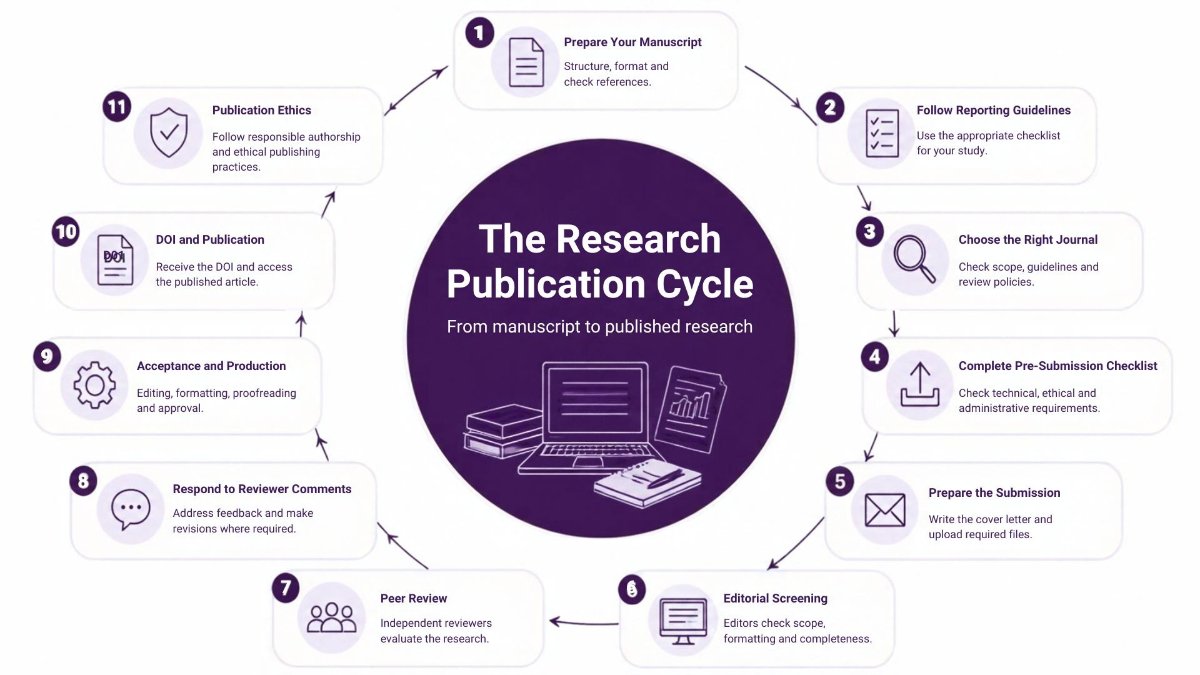
Simple Research Publication Roadmap
Research Publication Roadmap
- Prepare and check the manuscript
- Follow the required reporting guidelines
- Choose and verify the right journal
- Complete ethical and technical requirements
- Submit the manuscript
- Complete editorial screening
- Complete peer review and revisions
- Receive the final decision
- Complete editing and proof review
- Receive the DOI and publication
- Check the published article
Final Thoughts
Publishing a paper is a step-by-step process, from preparing the article and selecting your journal through submission, reviews, and requests for revisions, through to the ethics, DOI, and final publication of your research paper. This article pulls together all these elements to make the process a lot easier to understand. It is much easier to learn how to get a research paper published if you take a step-by-step approach and understand at each stage what is involved in getting your paper published. Researchers can also seek publication support from Southern Cross Academic Press for journals and the publication process.
Frequently Asked Questions
1. How long does it take to publish a research paper?
The timeline varies depending on the journal and the manuscript. It can be affected by editorial screening, peer review, revision, production and publication.
2. Can I submit my paper to more than one journal?
No. Researchers should not submit the same manuscript simultaneously to multiple journals. Wait for a final decision or formally withdraw it before submitting elsewhere.
3. What happens if my paper is rejected?
Read the decision and reviewer comments carefully. You may revise the manuscript for another suitable journal if the research remains appropriate for publication.
4. Do research papers always require peer review?
Not every scholarly publication follows the same review model. Check the specific journal's stated peer-review process before submission.
5. Should I check journal guidelines before submission?
Yes. Journal guidelines can specify manuscript structure, formatting, word limits, submission files, ethical declarations, referencing style and other requirements.
References
DeBehnke, D. J., Kline, J. A., Shih, R. D., & Research Committee of the Society for Academic Emergency Medicine. (2001). Research fundamentals: Choosing an appropriate journal, manuscript preparation, and interactions with editors. Academic Emergency Medicine, 8(8), 844–850. https://doi.org/10.1111/j.1553-2712.2001.tb00219.x
Phillips, V., & Barker, E. (2021). Writing for publication: Structure, form, content, and journal selection. Journal of Perioperative Practice, 31(6), 230–233. https://doi.org/10.1177/1750458921996249 DOI
Ochner, C. N., & Mineo, J. (2020). A brief tutorial on manuscript preparation: From journal selection to manuscript review. HCA Healthcare Journal of Medicine, 1(1), 3–10. https://doi.org/10.36518/2689-0216.1023 DOI
Tumin, D., & Tobias, J. D. (2019). The peer review process. Saudi Journal of Anaesthesia, 13(Suppl 1), S52–S58. https://doi.org/10.4103/sja.SJA_544_18
Wager, E., & Kleinert, S. (2014). Responsible research publication: International standards for authors. Prilozi, 35(3), 29–33. https://doi.org/10.1515/prilozi-2015-0005 PubMed