
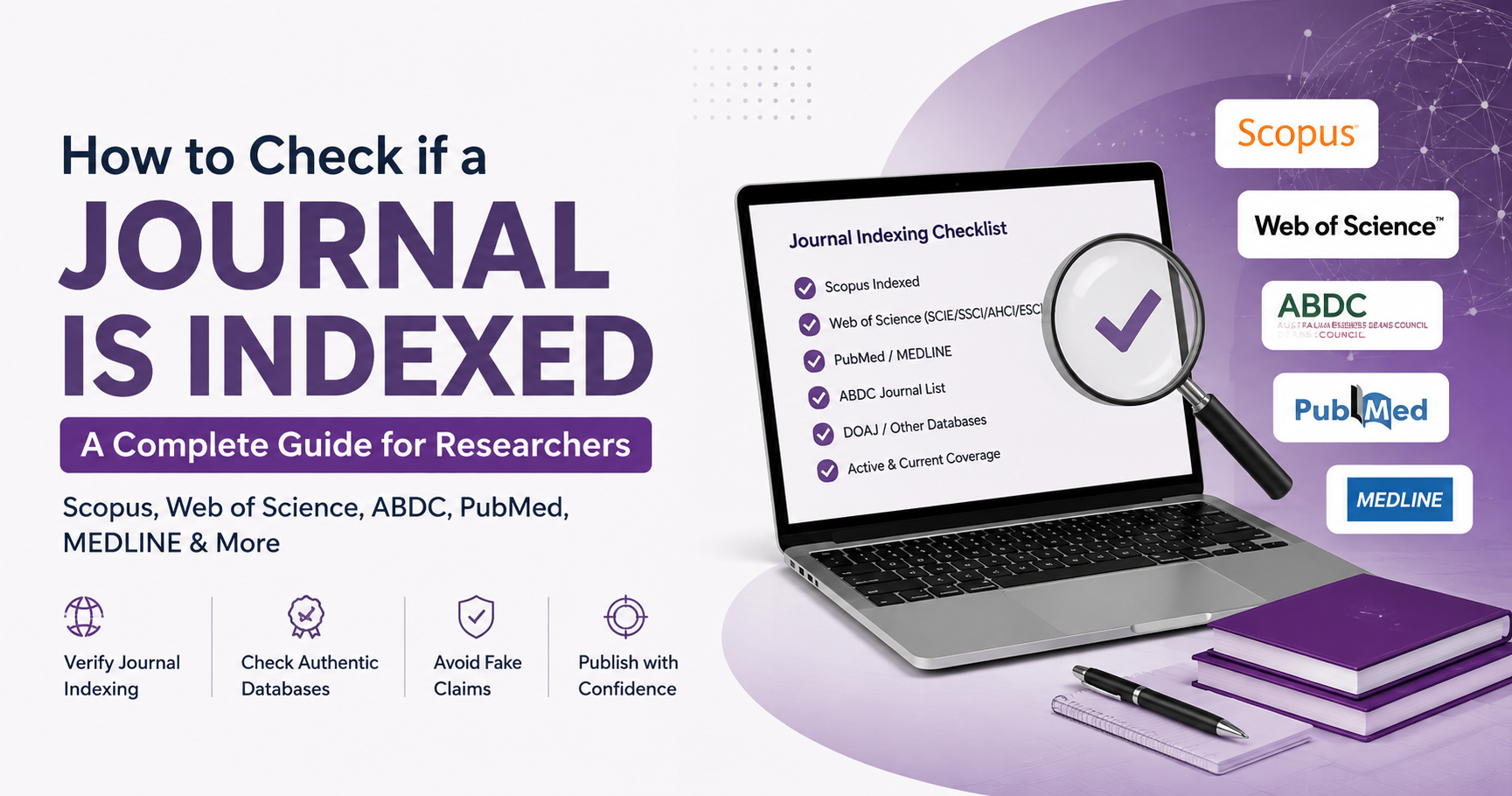
Scopus, Web of Science, ABDC & PubMed: Understanding Journal Indexing
The publication of a research paper is just one aspect of academic publishing. Once published, researchers also wish for their work to be found, indexed and visible to the appropriate academic audience. This is where journal indexing databases come in handy.
Journals have been referred to as Scopus indexed journals, Web of Science indexed journals, PubMed indexed journals or journals on the ABDC journal list. However, these terms are not synonymous.
This may be hard for a new researcher to comprehend. So what if Web of Science is not better than Scopus? Is ABDC is an indexing database? Is the journal listed in PubMed equal to it being indexed in MEDLINE? Journal indexing vs journal ranking?
This guide provides answers to these questions in an easy-to-understand format. It gives an explanation of how the leading journal indexing systems operate, what they are used for and their differences, and how a researcher can check the validity of a journal before submitting a paper.
What Is Journal Indexing?
Journal indexing involves making a journal or published journal content available for research in a scholarly database or indexing service to enable researchers to find and search for it.
Consider an academic database a big, systematic library catalog. Researchers can search one platform via:
- Article title
- Author name
- Keywords
- Journal title
- Subject
- Publication year
- DOI or other identifiers
The basic function of academic journal indexing is to find the articles published in journals.
Once a journal is added to a database that is recognized, articles in that journal may be easier to find by researchers. But once the journal is indexed, this does not imply that all of the databases will rank it in the same way or provide the same metrics.
That's a crucial difference.
The various journal indexing systems serve different purposes and are selected for different reasons, cover different topics and are evaluated in different ways. Major databases that search for research and citations, such as Scopus and Web of Science, provide large amounts of data. PubMed is primarily a biomedical and life-sciences literature database, whereas ABDC is a journal quality list of literature related to the business area.
Why Does Journal Indexing Matter?
Researchers often hear that they should publish in an "indexed journal." But why does it matter?
Publishing with good research journal indexing can facilitate discovery of published work, and can aid researchers in locating relevant literature for reviews, dissertations, theses and new studies.
Also, where universities, research institutions, funding agencies or employers have specific requirements for publications, indexing can be important.
An investigator, for instance, might be requested to write in:
- A Scopus-indexed journal
- A Web of Science Core Collection journal
- An SCIE or SSCI journal
- An ABDC-rated journal
- A PubMed or MEDLINE-covered journal
These requirements cannot be substituted for one another.
The types of databases required by a medical researcher and a business researcher are entirely different. It is important to select a database based on your topic and your academic need and not only based on the question of which database is "best."
Scopus: What Researchers Need to Know
What Is Scopus?
Scopus is a large, multi-disciplinary abstract and citation database for use by researchers, universities, libraries and research organisations.
The Scopus database covers a broad subject area and includes journals, conference proceedings and book series. According to Elsevier, its independent Content Selection and Advisory Board (CSAB) review and select Scopus content.
This is the reason that research workers always explore Scopus indexed journals when it comes to finding journals which have recognised database coverage.
Scopus encompasses topics in:
- Science
- Engineering
- Medicine
- Social sciences
- Business
- Economics
- Arts and humanities
- Computer science
So, Scopus is not a specialized medical database but rather its main strength is its ability to offer wide coverage in multidisciplinary areas.
How Does Scopus Journal Indexing Work?
Just because a journal displays a "Scopus Indexed" logo on its website does not make it indexed in Scopus.
Journals are assessed based on Scopus's technical and qualitative standards. Titles recommended by the suggested book list are forwarded to the Content Selection and Advisory Board for consideration for inclusion in the list of books for review.
This is why it is important to verify.
Even if a journal claims to be indexed in Scopus, the journal's website should not be the only source to consult, but it is important to also check the source information published by the official Scopus site.
What Does Scopus Provide Beyond Indexing?
Scopus's citation-related information and research metrics is another reason why researchers are interested in the platform.
The researchers might find the following metrics in different journals and/or based on data available:
- CiteScore
- Citation counts
- SJR-related information through other services
- Author citation information
- h-index information
But remember:
When a journal is in Scopus, you will learn about its coverage by the journal. A metric or ranking provides you with a different perspective on its citation performance or relative ranking.
Web of Science: What Researchers Need to Know
What Is Web of Science?
The Web of Science database is a major research discovery and citation platform maintained by Clarivate.
Web of Science indexing allows researchers to search for scholarly publications and analyze the connections between them.
The Web of Science Core Collection uses editorial evaluation and curation. Clarivate claims its journal evaluation process employs quality and impact criteria.
That's why people typically look for Web of Science indexed journals when they have a particular Web of Science requirement for their university or institution.
What Is Web of Science Core Collection?
A common misconception is that the term "Web of Science indexed" refers to articles that are indexed in the Web of Science database.
One common source of confusion is the phrase "Web of Science indexed."
The major Core Collection indexes for journals are:
- SCIE – Science Citation Index Expanded
- SSCI – Social Sciences Citation Index
- AHCI – Arts & Humanities Citation Index
- ESCI – Emerging Sources Citation Index
Clarivate says that once a journal has been editorial and technical evaluated, it may be indexed to one of these Web of Science Core Collection databases.
SCIE vs SSCI vs AHCI vs ESCI
| Index | Main area |
|---|---|
| SCIE | Science, technology, medicine and related areas |
| SSCI | Social sciences |
| AHCI | Arts and humanities |
| ESCI | Emerging and developing scholarly sources across disciplines |
So, when someone says a journal is "Web of Science indexed," it is worth asking:
That small question can make a big difference when your university or institution has a specific publication requirement.
ABDC: What Is the ABDC Journal List?
While ABDC is sometimes mentioned in the same breath as Scopus and Web of Science, there is a crucial difference.
The ABDC journal list is related to Australian Business Deans Council and is especially useful for disciplines of business and management.
ABDC rates the quality of journals in the following ways:
- A*
- A
- B
- C
The ABDC Journal Quality List has been developed and reviewed using expert assessment. The 2025 review will take into account journal rankings, new journal inclusion, removal of weak and/or predatory journals, changes in research-field classification and changes in the journal title.
This is appropriate for research activities in areas like:
- Accounting
- Finance
- Marketing
- Management
- Business
- Economics
- Tourism
- Information systems
- Human resources
- Strategy
What Do A*, A, B and C Mean in ABDC?
The ratings will help to differentiate journal based on the ABDC's journal quality assessment.
In simple terms:
- A* represents the highest ABDC category.
- A represents a highly regarded category below A*.
- B represents another recognised category of journals.
- C represents journals that meet the list's inclusion requirements but sit below the higher categories.
These labels should not be interpreted as being the same as Scopus quartiles or Web of Science metrics.
Another key reason why it is important to understand the difference in indexing and ranking a journal.
PubMed: What Researchers Need to Know
What Is PubMed?
PubMed is a free database for searching biomedical and life-sciences literature.
It is especially suited for researchers involved in the following fields:
- Medicine
- Nursing
- Pharmacy
- Public health
- Biology
- Biomedical sciences
- Dentistry
- Healthcare
- Life sciences
According to the official information on PubMed, it "includes citations and abstracts of biomedical and related life-sciences literature and links to full text when available."
This is especially the case for researchers in medical and health sciences fields, as PubMed indexes journals.
PubMed vs MEDLINE vs PubMed Central
This is one of the areas that often causes confusion.
PubMed, MEDLINE and PubMed Central (PMC) are not the same thing.
PubMed
The literature searchable resource is PubMed. It collects information from various National Library of Medicine databases.
MEDLINE
PubMed is heavily indexed by MEDLINE. MEDLINE is the National Library of Medicine's premier bibliographic database for life-sciences literature, with a strong focus on biomedicine. It is indexed by Medical Subject Headings (MeSH).
PubMed Central
PubMed Central is an open access full-text archive of biomedical and life-sciences journal literature. Unlike PubMed, PMC's emphasis is on preserving and making available the full text.
| Platform | Simple explanation |
|---|---|
| PubMed | Searchable database for biomedical and life-sciences literature |
| MEDLINE | Major bibliographic database and primary component of PubMed |
| PMC | Free full-text archive |
Therefore, it is not necessarily true that:
They are connected, but do different things.
Scopus vs Web of Science vs ABDC vs PubMed
Now we can answer the question researchers usually have: How are these four platforms different?
| Feature | Scopus | Web of Science | ABDC | PubMed |
|---|---|---|---|---|
| Main purpose | Abstract and citation database | Research and citation database | Journal quality list | Biomedical literature database |
| Subject coverage | Multidisciplinary | Multidisciplinary | Mainly business-related fields | Biomedical and life sciences |
| Citation information | Yes | Yes | Not its primary purpose | Available in a more limited form |
| Journal ratings | Metrics available | Metrics available for eligible journals | A*, A, B, C | Not a journal ranking system |
| Best suited for | Multidisciplinary research | Multidisciplinary research | Business and management | Medicine and health sciences |
| Main thing to check | Scopus source coverage | WoS Core Collection index | ABDC rating/list | PubMed/MEDLINE coverage |
| Full-text archive | No | No | No | PMC is a related full-text archive |
The key point is simple:
The right choice depends on your discipline and what your university, employer, funding agency, or research project requires.
Journal Indexing vs Journal Ranking: What Is the Difference?
This is one of the most important concepts to understand before choosing a journal.
Journal indexing and journal ranking are related, but they are not the same.
Journal indexing
Indexing answers:
Journal ranking
Ranking answers:
For example, Scopus provides database coverage and citation-related metrics. Web of Science provides coverage through its Core Collection and supports citation analysis. ABDC provides journal quality classifications for business-related fields.
This is why journal indexing vs journal ranking should not be treated as two names for the same thing.
A journal can be indexed in a database without automatically being a top-ranked journal.
Indexing vs Impact Factor vs CiteScore vs Quartile
Researchers also often mix these terms together.
| Term | What it generally tells you |
|---|---|
| Indexing | Whether content is covered by a particular database |
| Impact Factor | A journal citation metric associated with Journal Citation Reports |
| CiteScore | A Scopus-based citation metric |
| Quartile | A journal's relative position within a particular subject category |
| ABDC rating | A journal quality classification such as A*, A, B or C |
For example, saying:
is different from saying:
Likewise:
is different from:
These distinctions may help researchers avoid being misled with the vague claims posted on websites of journals.
Can One Journal Be Indexed in Multiple Databases?
Yes.
A journal can be part of multiple databases or indexing services.
For instance, a journal about a particular subject and on a particular stage of evaluation can be covered in:
Scopus + Web of Science
or:
Scopus + ABDC
or:
Scopus + PubMed
Or a few other pertinent services.
This is not an uncommon situation.
But every database has its own criteria for the evaluation of journals. If one database accepts, it is not guaranteed that every database will accept.
When assessing journals, the ABDC's own review documentation for example does not consider inclusion in Scopus and ABDC classification as the same.
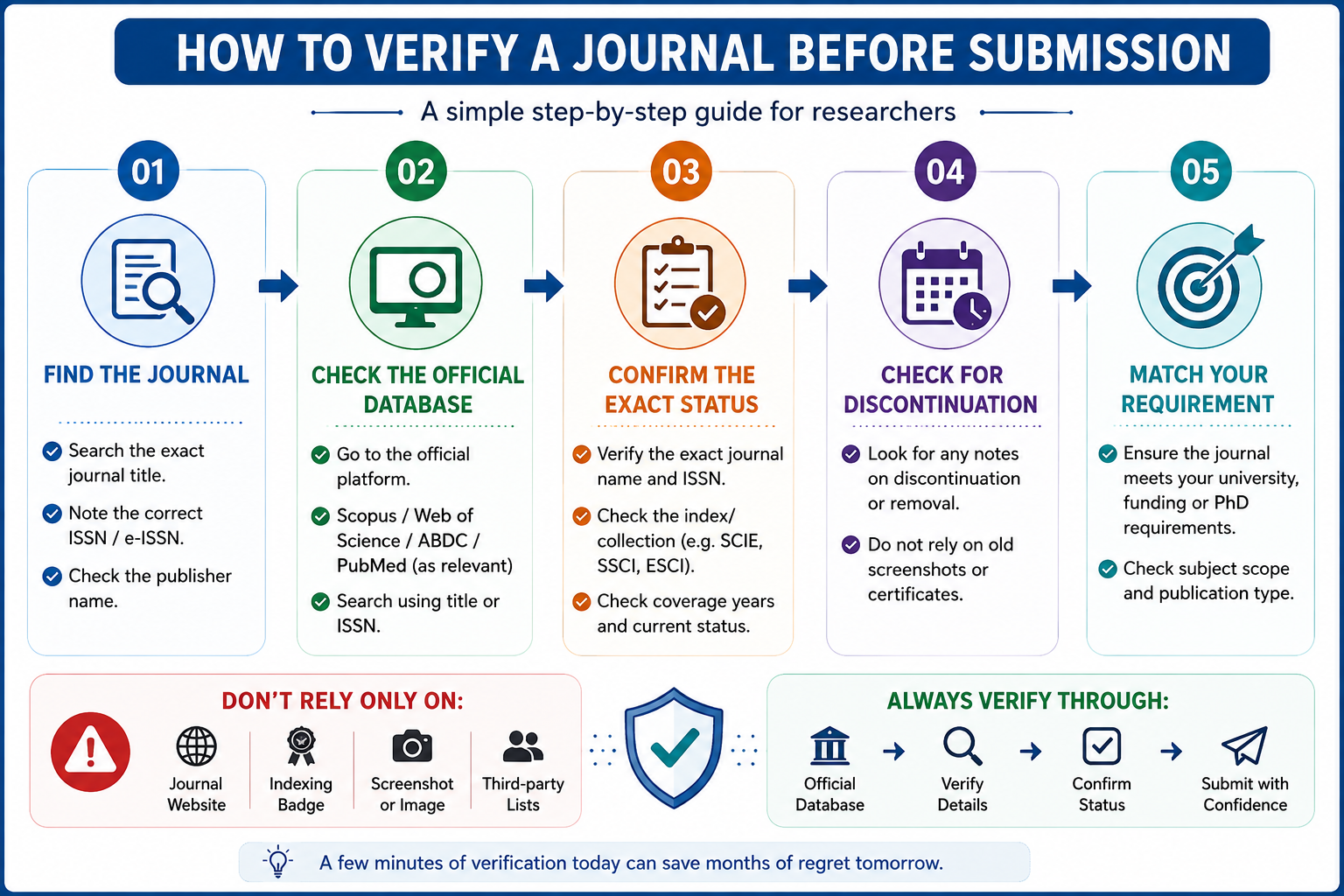
How to Check If a Journal Is Really Indexed
Don't assume "Indexed in Scopus" or "Web of Science" logo on the journal website when submitting your paper.
Spend a few minutes testing to make sure it is correct!
How to Check Scopus Indexing
Use the official source information for Scopus to search for the journals that are indexed in Scopus.
- Journal title
- ISSN
- e-ISSN
- Publisher information
Make sure that the actual journal you have found is the same as the journal listed in the database.
Consider coverage information and status as well.
Scopus sources information on its indexed sources and regularly checks source quality.
How to Check Web of Science Indexing
Use the official Web of Science journal information or Master Journal List for Web of Science indexing.
Check:
- Exact journal title
- ISSN/e-ISSN
- Publisher
- Web of Science collection
- Current coverage
First and foremost, be able to determine if the journal is included in:
- SCIE
- SSCI
- AHCI
- ESCI
According to Clarivate, those journals that are chosen for the Core Collection are subject to editorial and technical assessments prior to inclusion in the appropriate index.
How to Check the ABDC Journal List
Look in the list of official ABDC journals and check:
- Exact journal title
- ISSN
- Current rating
- Relevant research field
Avoid accepting a publication's self-described label, e.g., "ABDC A journal."
The official ABDC material reveals that journal ratings and inclusion will be reviewed.
How to Check PubMed and MEDLINE
To find a medical or health article, or journal, search the journal or article directly in PubMed.
If your institution requires MEDLINE indexing, you should not only view the journal or article in PubMed, but also when indexing the article in MEDLINE. See if the journal cited is included in MEDLINE.
As PubMed itself describes, material from MEDLINE, PMC and other NLM resources are included in PubMed.
What Does "Discontinued" Mean?
Also, it should be noted that coverage may vary from one issue of the journal to the next.
A journal that was covered by a database in the past may not necessarily have the same status forever.
This is particularly important when checking Scopus coverage. Continuous content evaluation is used to achieve the quality of sources in Scopus.
So, it is best to determine the current database status, not rely on:
- Old screenshots
- Old indexing certificates
- Previous-year lists
- Publisher advertisements
- Third-party websites
This is one of the reasons why it is important to verify journals shortly before submission.
How to Avoid Fake Indexing Claims
Unfortunately, some journals make themselves look established by using impressive looking badges and phrases.
Here are some claims that may be encountered:
- "Scopus approved"
- "Web of Science recognised"
- "Global indexed journal"
- "International impact factor"
- "ISI indexed"
- "PubMed indexed"
- "ABDC approved"
These statements should not automatically be trusted.
The better practice would be to check it against the official source of the journal.
Before submitting, check:
- Is the exact journal title listed?
- Does the ISSN match?
- Is the publisher name correct?
- Is the coverage current?
- Which specific index includes it?
- Is the journal listed as discontinued?
- Does the database claim match your university's requirement?
A journal internet site can make a claim. It needs to be verified on the official database.
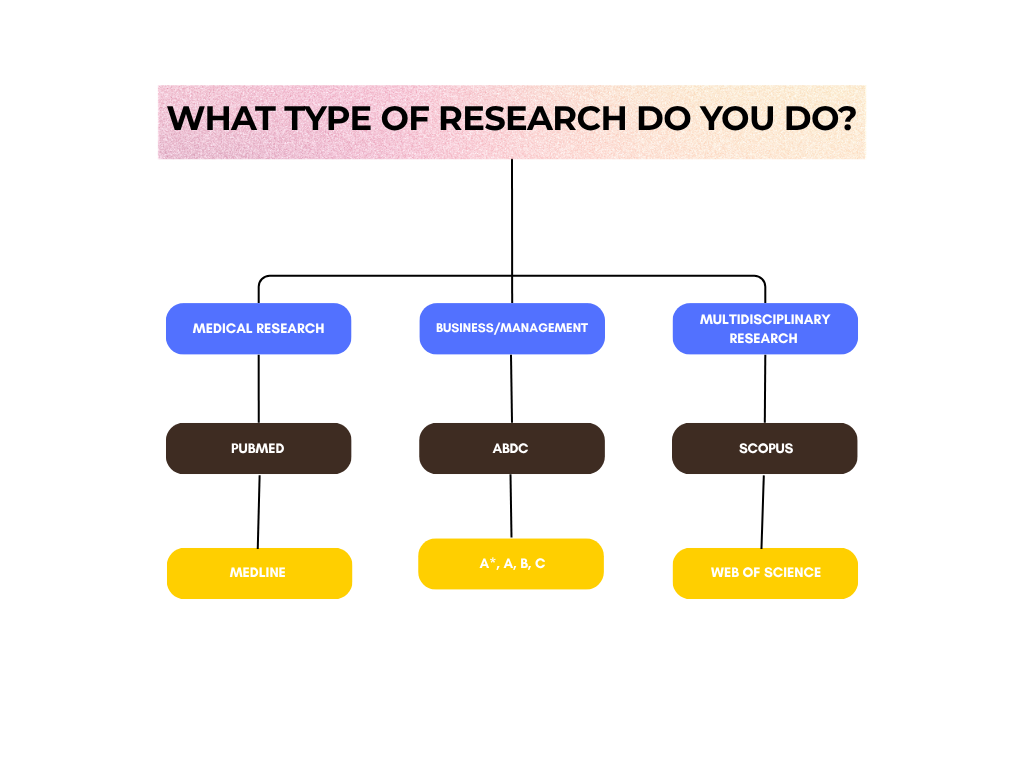
Which Database Is Best for Your Research?
Instead of asking "Which is the best indexing database?", ask:
If you are working in medicine or health sciences
PubMed and, where required, MEDLINE may be especially relevant.
If you are working in business or management
The ABDC journal list can be important, particularly when your institution recognises ABDC classifications.
If you need multidisciplinary citation coverage
Scopus can be a useful option because of its broad subject coverage.
If your institution requires Web of Science
For the general term 'Web of Science indexed' look for the specific Core Collection index, e.g. SCIE, SSCI, AHCI or ESCI.
If your university has a specific publication policy
Do the university's required.
For instance, if your PhD stipulations state "SCIE indexed journal", then getting it published in a journal that is simply listed as "internationally indexed" will NOT meet the requirements.
Frequently Asked Questions
1. What are journal indexing databases?
Journal indexing databases are searchable databases that organise and make scholarly publications searchable. They guide researchers to find academic articles, journals, authors and other research.
2. Is Scopus better than Web of Science?
Neither works for all researchers. Both offer wide coverage of research and citations, but you should choose the one that suits your need, depending on your research interests, institution and publication needs.
3. Is ABDC an indexing database like Scopus?
Not exactly. ABDC is a list of journals and is mostly for business related disciplines and has classifications of A*, A, B and C. It should not be seen as being the same as a multidisciplinary citation database like Scopus.
4. What is the difference between PubMed and MEDLINE?
PubMed is the larger searchable resource while MEDLINE is its largest part and one of the largest bibliographic databases, maintained by the U.S. National Library of Medicine. MeSH terms are used to index records in MEDLINE.
5. How can I check whether a journal is really indexed?
Search for the journal using its exact title and ISSN in the relevant official database or journal list. For Scopus, Web of Science, ABDC and PubMed, always verify the current status through the appropriate official source rather than relying only on the journal's website.